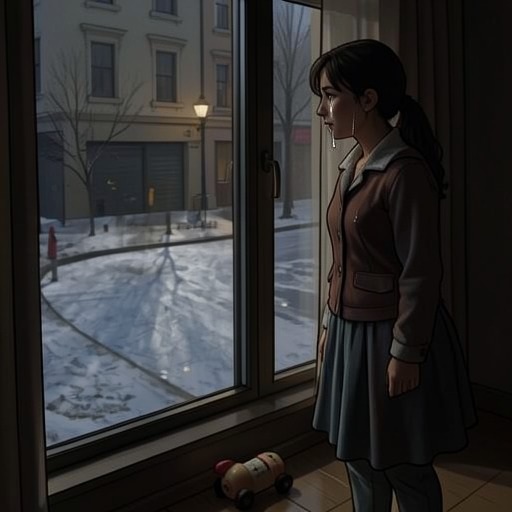
Planet My Baby Died
Tiny Beautiful Things: Advice on Love and Life from Dear SugarPlanet My Baby Died is Cheryl Strayed / Sugar’s metaphor for the world inhabited by a parent after a child has died. It names grief not as a stage that outsiders can set a timetable for, but as a changed reality that can separate the bereaved from people who have not experienced the loss. The expression’s force lies in holding two claims together: the death cannot be made all right, yet the grieving person is not alone and can find ways to live within a life permanently altered by it.
A world divided by loss
In her reply to Stuck, whose baby girl has died, Cheryl Strayed / Sugar contrasts the bereaved person’s world with the ordinary world around her: “They live on Planet Earth. You live on Planet My Baby Died.” The imagined planet is not a place to escape from or a condition that can be corrected by reassurance. It gives a name to the gulf between someone who has lost a child and people who have not had to learn what that loss means from the inside.
That gulf becomes especially painful when other people urge the bereaved parent to be over the death. Some may believe they are helping by minimizing the grief; others, Cheryl Strayed / Sugar suggests, are frightened by its intensity and try to push it away with their words. They may still love the grieving person and deserve her love, but that does not make them the people best able to help her heal. The metaphor therefore challenges a social expectation as well as describing private pain: the problem is not that the bereaved person has failed to return to normal, but that others mistake the scale of the loss or cannot bear to witness it.
Finding others who know the terrain
Cheryl Strayed / Sugar rejects the conclusion that Stuck is alone on this planet. Other women, she says, are reading with tears in their eyes; some privately repeat the words daughter or son, while others torment themselves over actions they fear may have caused their babies’ deaths. The details give the community she imagines a particular shape: its members share not only sorrow, but also the inward, often unspoken questions and self-blame that can accompany it. She calls these women Stuck’s tribe, locating companionship in recognition rather than in a promise that another person can undo the loss.
The recommendation is concrete. She urges Stuck to contact local hospitals and birth centers about support groups for people who have lost babies at, before, or shortly after birth; to read Elizabeth McCracken’s memoir An Exact Replica of a Figment of My Imagination; and to seek online communities where conversation does not require pretending. Even a microscopic exchange with someone who understands immediately because she has lived through a similar loss, Cheryl Strayed / Sugar writes, can have healing power. Connection does not erase the planet’s defining fact. It interrupts the isolation of having to explain it to people who have never been there.
Reaching without leaving the child behind
The metaphor leads to an instruction: reach. Cheryl Strayed / Sugar encourages Stuck to stop concealing her feelings from her boyfriend, to tell him the anger she feels and why, and to ask about his experience of their daughter’s death without measuring it against her own. She also recommends therapy, both individually and with her boyfriend, so that Stuck can examine her complex grief and manage what Cheryl Strayed / Sugar describes as probably situational depression. These are not presented as ways to leave the daughter behind. Reaching is instead a means of living a life that includes the loss without being arrested by it.
The response describes healing as arduous and incomplete rather than as a return to a previous self. Its hoped-for destination is a life in which grief remains, but the bereaved person can also feel fortunate to have had the privilege of loving her daughter. Cheryl Strayed / Sugar depicts that destination through contrasting images of darkness and light, scale and difficulty: healing is demanding, but Stuck’s letter already shows, in its grief, the capacity to travel toward it. The expression thus holds belonging and movement together. The planet is real; reaching does not deny it, but makes living there less solitary.
The author’s own experience of enduring grief
Cheryl Strayed / Sugar’s authority in this reply comes in part from her own bereavements, which she invokes without equating them with Stuck’s loss. She says she has lived on several planets unlike Earth. Elsewhere, she recalls that the last word her dying mother said to her was “love.” Her mother was too sick and weak to say the full phrase Cheryl Strayed / Sugar had spoken, but that single word endured as an expression of love in its own right. Her mother died alone in a hospital room, and for years Cheryl Strayed / Sugar repeatedly revisited the choices that had kept her from being present. The memory makes palpable the way bereavement can remain bound to an irreversible final moment.
After her mother died, Cheryl Strayed / Sugar found a glass jar of stones in the far reaches of her bedroom closet while clearing the home she had thought of as home. The stones had been gathered in childhood by Cheryl Strayed / Sugar, her brother, and her sister and given to their mother; holding the jar briefly felt like holding her mother. Yet the stones could not contain or restore the person she had lost. More than twenty years later, Cheryl Strayed / Sugar says she has stopped searching for a code to crack. The stones her children give her now occupy her pockets, where she sometimes carries one for weeks, finding and rubbing its smooth black arc. This continuing bond does not make the death acceptable. It shows how love can remain active in daily life even as grief changes shape.
Meaning and limits of the expression
Planet My Baby Died makes an intimate loss legible without reducing it to a problem outsiders can solve with a deadline or a consoling phrase. Its imagined geography marks the distance between those who have experienced a particular bereavement and those who have not; its community of fellow mourners offers recognition across that distance. The expression does not promise that shared understanding will make the death okay. Instead, it names the possibility of companionship, honest speech, and gradual movement while the loss remains part of the bereaved person’s life.